What is CBT
Cognitive Behavioral Therapy (CBT) is a practical, structured talking therapy that helps you identify and challenge unhelpful thoughts and behaviours. By changing how you think, you can improve how you feel and react to different situations.
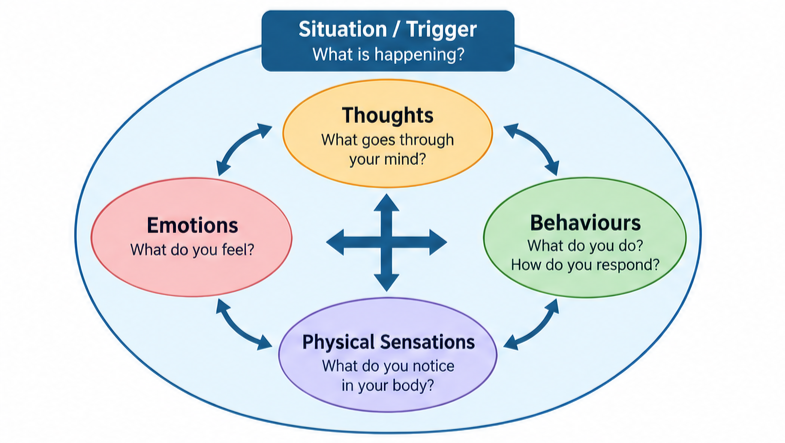
CBT is based on the idea that your thoughts, feelings, physical sensations and actions are all interconnected. An unhelpful thought can trap you in a negative circle.
Example 1:
Trigger: ‘Your colleague arrives at work and doesn’t greet you’
Thoughts: ‘I might have offended her yesterday without realising’, ‘she doesn’t like me’, ‘something is wrong with me’
Emotions: sadness and/or anxiety
Physical symptoms: nausea, sweating, fast heartbeat
Behaviour: we may become more withdrawn, avoidant;
Then a vicious circle is created that may result in more negative thoughts, more avoidance/withdrawal and then feeling worse- leading to increased sadness/anxiety.
CBT can help recognising patterns/negative circles and ‘break this vicious cycle’ by changing the way we behave and think.
Example 2:
you receive a sudden text from your boss asking to "talk later";
Trigger: Seeing the message from your boss.
Thoughts: "I made a huge mistake. I am going to get fired."
Physical Sensations: Your chest gets tight, and your heart races
Emotions: Intense panic and anxiety
Behavior: You call in sick or make an excuse to cancel the meeting
Short-Term Relief: Your anxiety drops immediately because you escaped the scary situation
Long-Term Result: Your brain learns that avoidance is the only way to survive. The next time a similar event happens, the anxiety returns stronger because you never tested whether your scary thought was true
Core beliefs in CBT
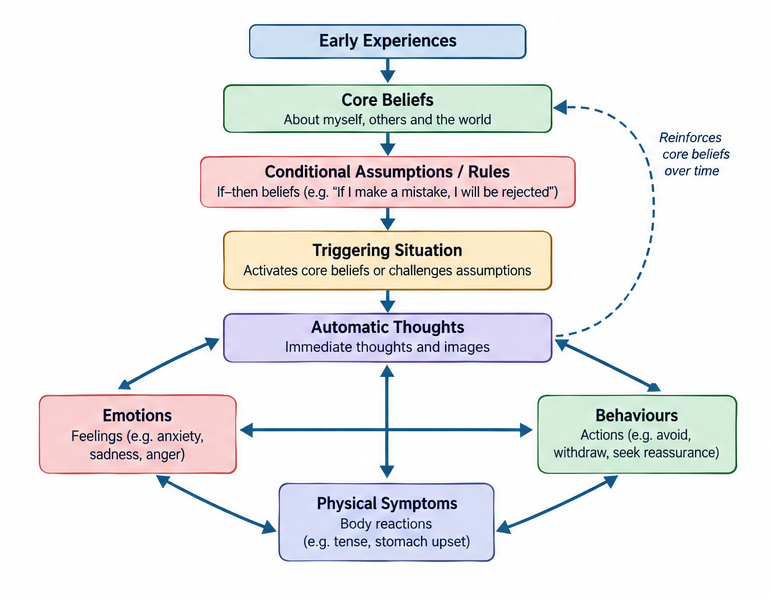
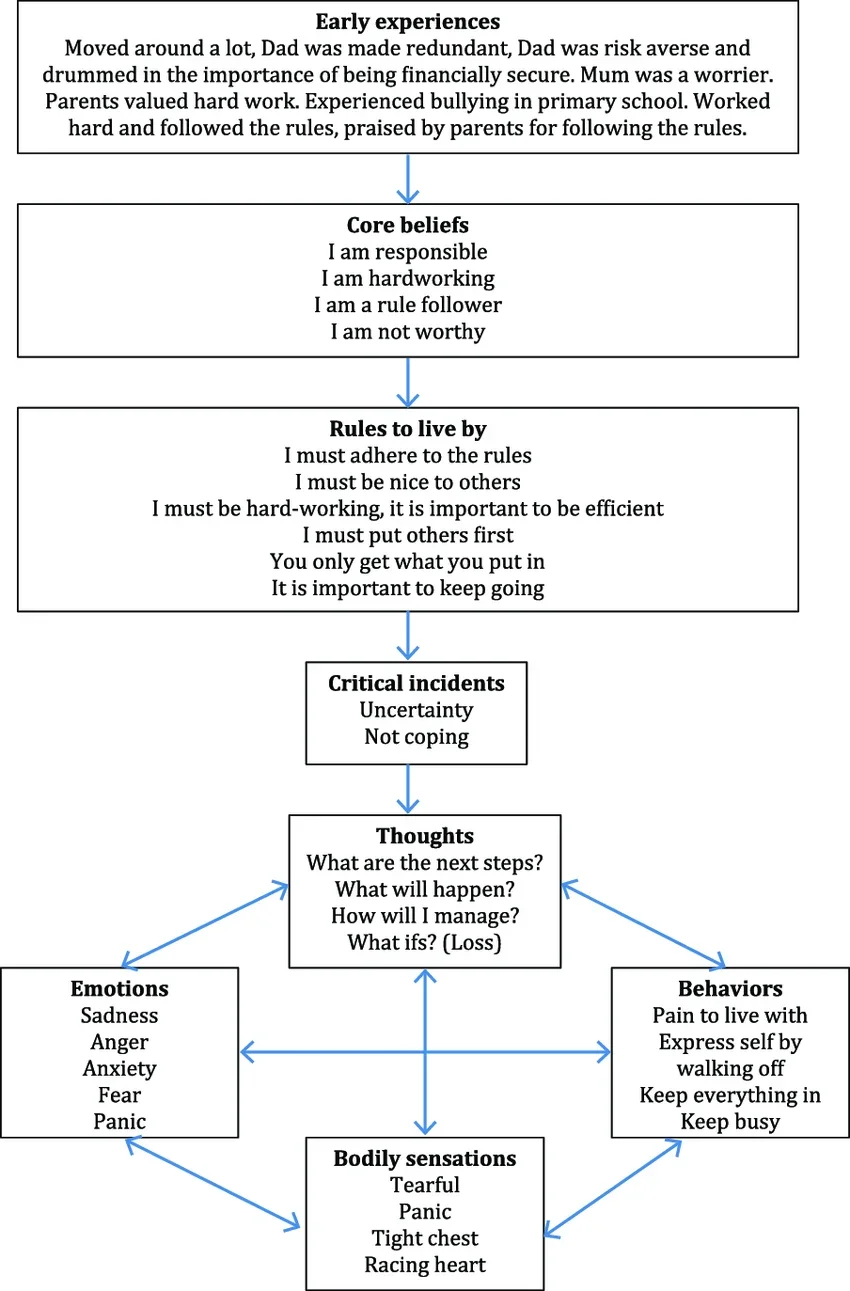
Core beliefs are deeply ingrained absolute ideas that people hold about themselves, other people and the world. These rules act like a filter and shape how you see every event in your daily life.
Examples of Core Beliefs and Daily Effects
1. Helpless Core Beliefs
The Belief: "I am weak" or "I am incompetent"
Daily Effect: You might avoid new tasks at work or school. You may second-guess your choices. When a small problem happens, you feel overwhelmed quickly. You might rely heavily on others to make decisions for you.
2. Unlovable Core Beliefs
The Belief: "I am unlovable," "I am defective"
Daily Effect: You might pull away from people before they can reject you. You may stay in bad relationships because you feel you do not deserve better. You might over-analyze text messages or social cues, looking for signs that someone is mad at you.
3. Worthless Core Beliefs
The Belief: "I am a failure," "I am not good enough" or "I am a bad person", “I am inferior”
Daily Effect: You might work constantly to prove your worth (perfectionism, ‘high standards’), leading to burnout. You might brush off praise or compliments because you do not believe them. When you make a minor mistake, you tell yourself that your whole life is ruined.
How Core Beliefs Work in Daily Life
The Event: Something happens (e.g., your boss asks to speak with you).
The Filter: Your core belief ("I am incompetent") triggers an automatic thought ("I am going to get fired").
The Feeling: You feel intense fear or sadness.
The Action: You act based on the fear (e.g., you lose sleep, feel sick, or trying to avoid meeting with your boss).
What CBT sessions involve
In CBT, the main aim is making changes to solve your problems.
In a typical CBT session, you'll talk about situations you find difficult, and discuss how they make you think, feel and act.
You'll work with your therapist to work out different ways of approaching these situations. This could include:
questioning unhelpful thoughts and beliefs, and considering other ways of looking at things
noticing your emotions and physical feelings without reacting to them
changing what you do, for example, doing activities you've been avoiding
Your therapist will help you find approaches that work for you and the problems you're having.
You'll usually be asked to practise what you've learned between sessions – it's important to do this for CBT to work. You may also be asked to record your progress in a worksheet or diary. The goal is that eventually you become your own therapist and able to independently use all techniques that you learnt for a healthier, happier you.